The Mental Abacus (Anzan) Secret: How Children Build a Supercomputer in Their "Mind's Eye"
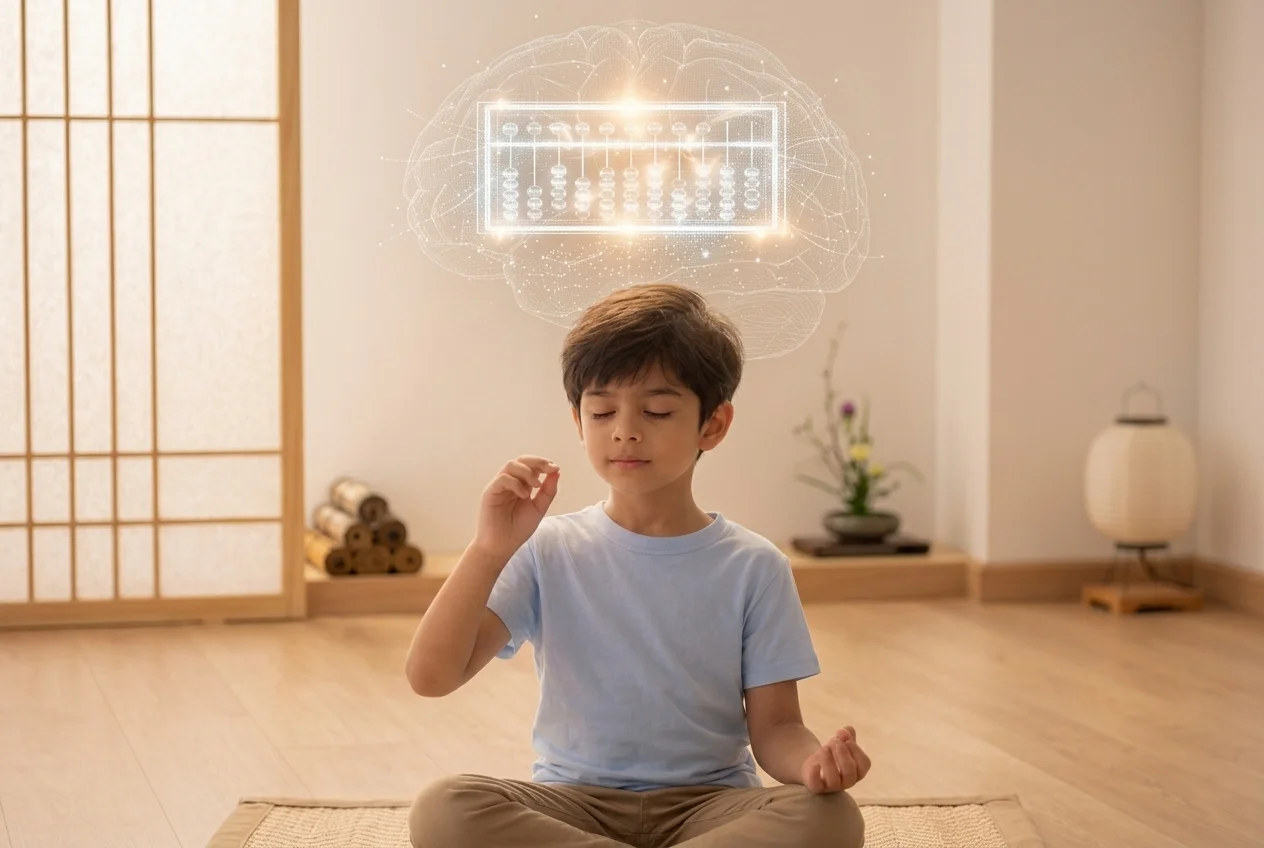
If you watch a high-level abacus student solve a long string of numbers, you will notice something peculiar. Their fingers twitch in the air, moving invisible beads, while their eyes stare into a space only they can see. In seconds, they provide an answer that would take most adults a minute to type into a calculator.
This isn't magic. It is Anzan—the Japanese art of the Mental Abacus. While the physical abacus is a powerful tool, Anzan is the "ultimate upgrade." It is the moment the hardware of the wooden beads is successfully installed into the software of the human brain. To understand the future of human intelligence, we must understand how this visual supercomputer is built.
The Neural Switch: From Logic to Vision
Most people process math in the Left Hemisphere of the brain. This is the area responsible for language, linear logic, and verbal symbols. When you see "5 + 5," your left brain processes the word "five" and the symbol "+". This process is effective but slow because it relies on linguistic decoding.
Anzan training forces a "Neural Switch." By practicing with physical beads for hundreds of hours, the brain eventually migrates the mathematical process to the Right Hemisphere—the area responsible for visualization, spatial awareness, and "big picture" thinking. Instead of processing a number as a word, the child's brain processes it as a picture. Images move faster than words. This is why Anzan students calculate at the speed of thought.
1. The Creation of the "Mental Screen"
The first step in Anzan is the creation of a stable "Mental Screen." A student must be able to close their eyes and see a 13-column Soroban as clearly as if it were sitting on the desk in front of them. This requires extreme Visual Working Memory.
In 2026, where digital distractions have fragmented our ability to hold single thoughts, this training is a superpower. By forcing the brain to hold a complex, moving image steady, we are essentially strengthening the "RAM" of the child's mind. This increased memory capacity naturally flows into other subjects like science, where complex systems must be visualized to be understood.
2. The "Twitch" – Kinetic Memory
You may have noticed Anzan students moving their fingers in the air. This is called Kinetic Visualization. The brain links the visual image of the bead to the physical sensation of the finger movement. This creates a "double-lock" on the information.
Even if the visual image flickers for a second, the muscle memory in the fingers "knows" where the beads are. This multi-sensory integration (Visual + Tactile + Auditory) is why abacus learners retain information so much longer than those who learn via traditional rote memorization. They aren't just remembering a fact; they are remembering a movement and a shape.
3. Calculating at "Subconscious" Speeds
The final stage of Anzan is Automaticity. High-level students don't "think" about the formulas (like the Big Brother or Small Sister rules). The movement happens subconsciously. When the ears hear a number, the mental beads move instantly.
This frees up the conscious mind for higher-level tasks. While the subconscious "Abacus Engine" handles the arithmetic, the conscious mind can focus on the context of the problem, the logic of the physics equation, or the strategy of a chess game. This is the definition of a "Master Mind"—one that can automate lower-level tasks to focus on high-level creativity.
How to Foster Anzan at Home
Transitioning from the physical tool to the mental one is the hardest part of the journey. Here is the My Abacus Pro strategy for success:
- The "Flash" Method: Use our digital "Bead Value" tool to show a bead image for only 0.5 seconds. This forces the brain to "take a photograph" rather than count.
- Short Bursts: Practice Anzan for 5 minutes, three times a day. Visualization is exhausting for a young brain; frequency is better than duration.
- Eyes Closed, Ears Open: Read numbers aloud to your child while they keep their eyes closed. This forces them to rely 100% on their mental screen rather than looking at a page.
Conclusion: The Ultimate Mental Hardware
Anzan is the greatest gift we can give a child in the age of AI. As machines take over the "doing," we must empower our children with the "seeing." By building a mental abacus, your child isn't just learning to calculate; they are learning to master their own internal focus in an increasingly noisy world.
Watch the Magic Happen
Our digital Anzan training module is designed to help students transition from physical beads to mental mastery in record time. Are you ready to see what your child's brain is truly capable of?
Try our Mental Visualization Drill →Put these techniques into practice
Want to build the lightning-fast calculation skills mentioned in this article? Our specialized practice tools allow you to drill these specific formulas.
Used by 1,000+ students worldwide to master Soroban techniques.
Written By
Satish Mane (Abacus Trainer)